Oxford University Press's
Academic Insights for the Thinking World

A new era at the American National Biography

In April 2012, the American National Biography gladly received a new general editor: Susan Ware. Mark Carnes welcomed his successor, saying, “A superb choice! Susan Ware is an outstanding biographer, a proven editor, and a wonderful person. She will thrive in a job whose importance does not preclude it from being great fun.” We’re excited to have Susan leading the ANB and she’s offered a sneak peak of her plans for improving and extending this fantastic resource.
Read More
Book thumbnail image

Three Myths About the Muslim Brotherhood

By Steven A. Cook
Since Egypt’s Supreme Presidential Election Commission declared Mohamed Morsi the winner of the presidential election, there has been a lot of commentary about the Muslim Brotherhood. Morsi, an engineer by training, was a long time member of the Brotherhood and was a member of its political department. Morsi has resigned from both the Brotherhood and its party, Freedom and Justice, but that is more symbolic than substantive.

Read More
Book thumbnail image

How to become a doctor in the UK

By Iqbal Kahn
If you ask many people, “How long does it take to train as a doctor?”, the response would probably be five years. And many people joke that it takes longer to train as a vet than a medic! However the simple answer is that a doctor is always training in one form or another, and, that as medical professionals, we should always be striving to be the best.

Read More
Book thumbnail image

Does the Supreme Court care what the public think?

As we continue to look back on Thursday’s Supreme Court decision on the Affordable Care Act, the question of how the Court’s opinion was influenced by the public has been raised. To provide some background, we excerpted The U.S. Supreme Court: A Very Short Introduction by Linda Greenhouse.

Read More
Book thumbnail image

The transformation of listening with the Walkman

By Amanda Krause
Not long ago, I saw an image floating around the Internet. It simply displayed two items — a cassette tape and a pencil — along with the following statement: “our children will never know the link between the two.” Upon a quick search to locate that image the other day, it looks like it was the topic of a reddit post back in 2011. But as viral things tend to do, it lingered, making its way into Facebook posts and into Internet “age tests” aimed at prompting either confusion or nostalgic reflection.

Read More
Book thumbnail image

Will health care reform work in the end?

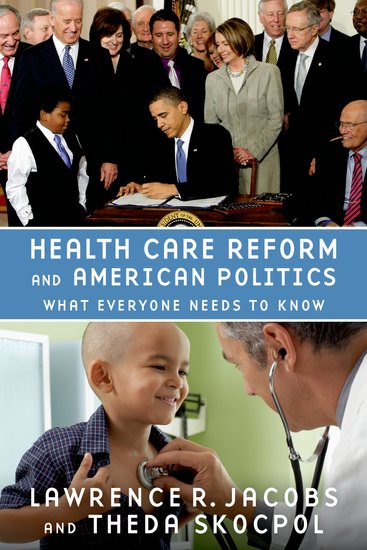
In light of the Supreme Court decision yesterday upholding the Affordable Care Act, I thought this brief excerpt from Health Care Reform and American Politics: What Everyone Needs to Know by Lawrence R. Jacobs and Theda Skocpol was in order.

Read More
Book thumbnail image

Barry Landau and the grim decade of archives theft

By Travis McDade

Ten years ago, responding to $200,000 worth of thefts by curator Shawn Aubitz, United States Archivist John Carlin said he had “appointed a high-level management task force to review internal security measures” at the National Archives. “A preliminary set of recommendations are under review and a number of new measures are already in place.” Four years later, an unpaid summer intern smuggled 160 documents out of the very same Archives branch. His only tool was a yellow legal pad.

Read More
Book thumbnail image

Jan Zalasiewicz and Mark Williams talk four billion years of climate change

Climate change is a major topic of concern today, scientifically, socially, and politically. But the Earth’s climate has continuously altered over its 4.5 billion-year history. Geologists are becoming ever more ingenious at interrogating this baffling, puzzling, infuriating, tantalizing, and seemingly contradictory evidence. The story of the Earth’s climate is now being reconstructed in ever-greater detail — maybe even providing us with clues to the future of contemporary climate change. Below, you can listen to Dr Jan Zalasiewicz and Dr Mark Williams talk about the topics raised in their book The Goldilocks Planet: The four billion year story of Earths Climate.

Read More
Book thumbnail image

Do we really need magnets?

By Stephen Blundell
Do you own any magnets?  Most people, when asked this question, say no.  Then they remember the plastic letters sticking to their refrigerator door, or the holiday souvenir that keeps takeaway menus pinned to a steel surface in their kitchen.  Maybe I do own a few, they say.

Read More
Book thumbnail image

Jean-Jacques Rousseau at 300

By Russell Goulbourne
Thursday 28 June 2012 marks the tercentenary of the birth of Jean-Jacques Rousseau, one of the most important and influential philosophers of the European Enlightenment. The anniversary is being marked by a whole host of commemorative events, including an international conference at my own institution, the University of Leeds, which begins today. Rousseau arouses this kind of interest because his theories of the social contract, inequality, liberty, democracy and education have an undeniably enduring significance and relevance. He is also remembered as a profoundly self-conscious thinker, author of the autobiographical Confessions and Reveries of the Solitary Walker.

Read More
Book thumbnail image

10 facts and conjectures about Edmund Spenser

By Andrew Hadfield
A particular anxiety/curiosity of any author who undertakes a work of biography is whether they have discovered anything new about their subject. I’m not sure that I have any ‘smoking gun’ for Edmund Spenser (1554?-1599) that conclusively proves something that no one knew before, and there is no one single archival discovery that can be trumpeted as a particular triumph. But I think I have rearranged and rethought Spenser’s life and its relationship to his work in some new ways. Here is a list of my top ten favourite Spenser facts and conjectures, some known, some less well known.

Read More
Book thumbnail image

Treaty of Versailles signed

This Day in World History
On 28 June 1919, in the famous Hall of Mirrors of the French palace at Versailles, more than a thousand dignitaries and members of the press gathered to take part in and see the signing of the treaty that spelled out the peace terms after World War I. American President Woodrow Wilson, British Prime Minister Lloyd George, and French Prime Minister Georges Clemenceau were the among the leaders in attendance.

Read More
Book thumbnail image

To be Commander-in-Chief

On April 4, 1864, Abraham Lincoln made a shocking admission about his presidency during the Civil War. “I claim not to have controlled events,” he wrote in a letter, “but confess plainly that events have controlled me.” Lincoln’s words carry an invaluable lesson for wartime presidents. Author Andrew J. Polsky believes when commanders-in-chief do try to control wartime events, more often than not they fail utterly. He examines Lincoln, Woodrow Wilson, Franklin D. Roosevelt, Lyndon Johnson, Richard Nixon, George W. Bush, and Barack Obama, showing how each gravely overestimated his power as commander-in-chief.

Read More
Book thumbnail image

Health care reform and federalism’s tug of war within

By Erin Ryan
This month, the Supreme Court will decide what some believe will be among the most important cases in the history of the institution. In the “Obamacare” cases, the Court considers whether the Affordable Care Act (“ACA”) exceeds the boundaries of federal authority under the various provisions of the Constitution that establish the relationship between local and national governance. Its response will determine the fate of Congress’s efforts to grapple with the nation’s health care crisis, and perhaps other legislative responses to wicked regulatory problems like climate governance or education policy.

Read More