Language history leading to ‘selfie’
By Melissa Mohr
To celebrate selfie’s tenure as Word of the Year, here are some WOTYs from the past, which may shed some light on its development.

Oxford University Press's
Academic Insights for the Thinking World
By Melissa Mohr
To celebrate selfie’s tenure as Word of the Year, here are some WOTYs from the past, which may shed some light on its development.
By Anatoly Liberman
There are many ways to be surprised (confounded, dumbfounded, stupefied, flummoxed, and even flabbergasted). While recently discussing this topic, I half-promised to return to it, and, although the origin of astonish ~ astound ~ stun is less exciting than that of amaze, it is perhaps worthy of a brief note.

By Katherine Connor Martin
Oxford’s lexicographers use the Oxford English Corpus (OEC), a 2-billion-word corpus of contemporary English usage gathered since 2000, to provide accurate descriptions of how English is used around the world in real life. A corpus is simply a collection of texts that are richly tagged so that they can be analyzed using software (we use the Sketch Engine).
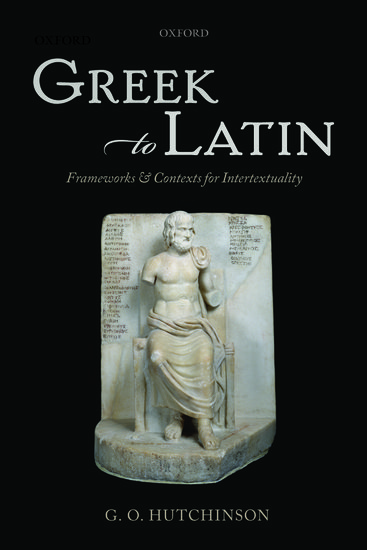
By G. O. Hutchinson
How could you have one novel, poem, children’s book, that wasn’t influenced by others? But people haven’t much considered what distinguishes literary interaction that jumps across languages and countries.
By Edwin Battistella
The annual Word of the Year selection by Oxford Dictionaries and others inspired me to an odd personal challenge last year. In November of 2011, about the time that Oxford Dictionaries were settling on squeezed middle as both the UK and US word of the year, I made a New Year’s Resolution for 2012.

When Oxford Dictionaries chose ‘selfie’ as their Word of the Year for 2013, we invited several scholars from different fields to share their thoughts on this emerging phenomenon.

Perhaps no speech in the canon of American oratory is as famous as the “Dedicatory Remarks” delivered in a few minutes, one hundred and fifty years ago, by President Abraham Lincoln. And though school children may no longer memorize the conveniently brief 272 words of “The Gettysburg Address,” most American can still recall its opening and closing phrases.
It’s that time of the year again. With a fanfare and a drum roll, it’s time to announce the Oxford Dictionaries Word of the Year. The votes have been counted and verified, and I can exclusively reveal that the winner is…. ‘Selfie’
By Anatoly Liberman
One of the minor questions addressed in my latest “gleanings” concerned the origin of the adjective brave. My comment brought forward a counter-comment by Peter Maher and resulted in an exchange of many letters between us, so that this post owes its appearance to him. Today I am returning to brave, a better-informed and more cautious man.
By Anatoly Liberman
Words, as I have noted more than once, live up to their sense. For instance, in searching for the origin of amaze, one encounters numerous truly amazing reefs. This is the story. Old English had the verb amasian “confuse, surprise.”
By Anatoly Liberman
Touch and go. I asked our correspondents whether anyone could confirm or disprove the nautical origin of the idiom touch and go. This is the answer I received from Mr. Jonathan H. Saunders: “As a Merchant Mariner I have used and heard this term for over thirty years.
By Anatoly Liberman
It is hard to hide something (anything) from Stephen Goranson (see his comment to Part 1), who will find a needle in a haystack, and The Canterville Ghost is a rather visible needle. Yet Oscar Wilde is no longer as popular as one could wish for.
By Anatoly Liberman
Don’t hold your breath: all three words, especially the second and the third, came in from the cold and will return there. Nor do we know whether anything connects them. Deuce is by far the oldest of the three. Our attestations of it go back to the middle of the seventeenth century.
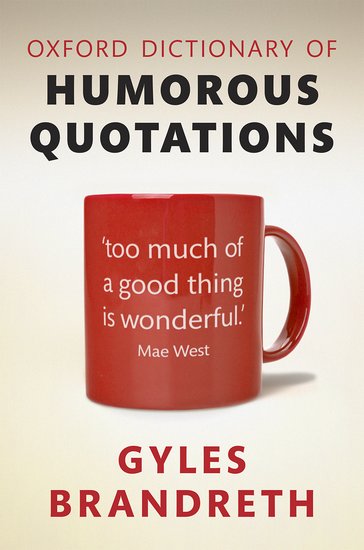
Today marks the publication of the fifth edition of the Oxford Dictionary of Humorous Quotations under the editorship of broadcaster and former MP Gyles Brandreth. But who is the wittiest of them all?
By Anatoly Liberman
Every word journalist is on the lookout for interesting pieces of information about language. H. W. Fowler, the author of the great and incomparable book Modern English Usage, confessed that his main reading was newspapers. Naturally: where else could he find so much garbled English?
By Anatoly Liberman
As promised, I am returning to the English verb brag and the Old Scandinavian god Bragi (see the previous post). If compared with boast, brag would seem to be more suggestive of bluster and hot air. Yet both may have been specimens of Middle English slang or expressive formations.