Oxford University Press's
Academic Insights for the Thinking World

Book thumbnail image

Robert Burns, digital whistle-blowing, and Scottish independence

By Robert Crawford
For the first time since 1707 (more than half a century before Burns was born), the population of Scotland is being given the chance to vote in a referendum that asks the question, ‘Should Scotland be an independent country?’ The referendum won’t be held until 18 September, but already people are arguing about which side Robert Burns would have been on.

Read More
Book thumbnail image

Rebecca Lane on publishing

By Rebecca Lane
As an English graduate, publishing seemed a natural choice when I started my job hunt. However, I little thought I would one day be commissioning Oxford Companions and Oxford Paperback Reference books — two series that helped me immensely during my studies.

Read More
Book thumbnail image

Paul Sax, MD on infectious diseases and journal publishing

The Infectious Diseases Society of America (IDSA) and the HIV Medicine Association (hivma) are launching a new peer-reviewed, open access journal, Open Forum Infectious Diseases (OFID), providing a global forum for the rapid publication of clinical, translational, and basic research findings.

Read More
Book thumbnail image

It’s time to rethink unemployment policy

By Gertrude Schaffner Goldberg
Lifeline benefits for millions of jobless workers still hang in the balance. The current debate over whether to maintain benefits for long-term unemployment underscores limitations in unemployment insurance that have plagued this program throughout its history.

Read More
Book thumbnail image

Anti-microbial resistance and changing the future

By Phil Ambery
It’s good to see the problem of anti-microbial resistance revisited by Professor Farrar — a timely reminder to us all of the potential dangers ahead. Memories are short, few will remember the days of the early 90s, when anti-HIV therapies were limited, as were the lives of patients with AIDS. Others will assume that the days of death by “consumption” have long since passed.

Read More
Book thumbnail image

A crossroads for antisemitism?

By Steven Beller
In the conclusion to Antisemitism VSI (2007) I saw antisemitism as an almost completely spent force. Events since then give one pause for thought. Israel appears no more accepted as a “good citizen” by much of the international community, and Jews continue to be attacked for their supposed support of the “Jewish state”.

Read More
Book thumbnail image

Were there armed conflicts in Mexico in 2012?

By Stuart Casey-Maslen
More than 9,500 people were killed in Mexico in 2012 as a result of armed violence, primarily as the result of conflict between the Sinaloa cartel, the Las Zetas gang, and the state. Tens of thousands of Mexican troops and police were involved in these conflicts, and more than 400 were killed during the year.

Read More
Book thumbnail image

The Banks O’ Doon

Robert Burns was born on 25 January 1759 in Alloway, a small village near the river Doon just south of the town of Ayr, in the south-west of Scotland. As Scots and Scotophiles to world over prepare to celebrate Burns Night tomorrow, here’s an excerpt from the new Oxford World’s Classics edition of his Selected Poems and Songs, dedicated to that river near which he grew up.

Read More
Book thumbnail image

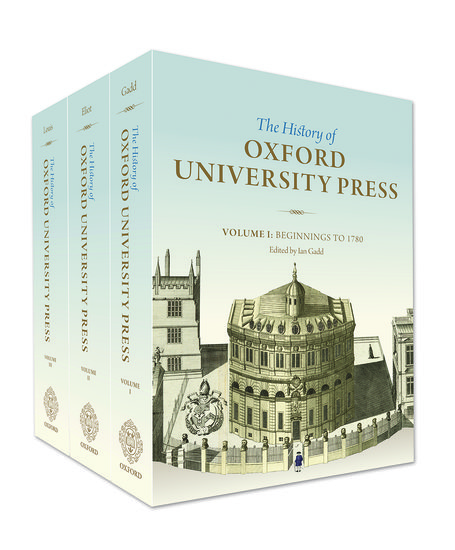
Damp paper and difficult conditions

By Simon Eliot
Oxford University was a large mass-producer of books by the 1820s. Despite this, it was still occupying a very elegant but modest-sized neo-classical building in the centre of Oxford designed for it in 1713 by Nicholas Hawksmoor. By the mid-1820s this building was bursting at the seams.

Read More
Book thumbnail image

Be Book Smart on National Reading Day

By Anne Cunningham and Jamie Zibulsky
If you want to help a child get ahead in school and in life, there is no better value you can impart to him or her than a love of reading. The skills that early and avid reading builds are the skills that older readers need in order to make sense of sophisticated and complex texts.

Read More
Book thumbnail image

Bernstein’s disturbing vision

By Jeremy Begbie
On my office wall I keep two photos together in a single frame. They show two teachers who inspired me more than any others—my first theology teacher, James Torrance (1923–2003), and next to him the American conductor, composer and pianist, Leonard Bernstein (1918–1990).

Read More

Whoa, or “the road we rode”

By Anatoly Liberman
The world has solved its gravest problems, but a few minor ones have remained. Judging by the Internet, the spelling of whoa is among them. Some people clamor for woah, which is a perversion of whoa and hence “cool”; only bores, it appears, don’t understand it. I understand the rebels but wonder.

Read More
Book thumbnail image

Five important facts about the Italian economy

Though the Eurozone crisis left many European countries struggling in its wake, Italy suffered one of the most crippling hits to its economy. As Gianni Toniolo notes in his edited volume, The Oxford Handbook of the Italian Economy Since Unification, between 2007-2009, there was a “loss of more than 5 percentage points in GDP per person, a decline comparable with that of the Italian Great depression of the early 1930s.”

Read More
Book thumbnail image

What the ovaries of dinosaurs can tell us

By Dr. Jingmai O’Connor
Understanding the internal organs of extinct animals over 100 million years old used to belong in the realm of impossibility. However, during recent decades exceptional discoveries from all over the world have revealed elusive details such as fossilized feathers, skin, and muscle.

Read More

Diseases can stigmatize

By Leonard A. Jason
Names of diseases have never required scientific accuracy (e.g. malaria means bad air, lyme is a town, and ebola is a river). But some disease names are offensive, victim-blaming, and stigmatizing. Multiple sclerosis was once called hysterical paralysis when people believed that this disease was caused by stress linked with oedipal fixations.

Read More