Oxford University Press's
Academic Insights for the Thinking World

  • Social Sciences

Book thumbnail image

Five important facts about the Italian economy

Though the Eurozone crisis left many European countries struggling in its wake, Italy suffered one of the most crippling hits to its economy. As Gianni Toniolo notes in his edited volume, The Oxford Handbook of the Italian Economy Since Unification, between 2007-2009, there was a “loss of more than 5 percentage points in GDP per person, a decline comparable with that of the Italian Great depression of the early 1930s.”

Read More
Book thumbnail image

What the ovaries of dinosaurs can tell us

By Dr. Jingmai O’Connor
Understanding the internal organs of extinct animals over 100 million years old used to belong in the realm of impossibility. However, during recent decades exceptional discoveries from all over the world have revealed elusive details such as fossilized feathers, skin, and muscle.

Read More

Diseases can stigmatize

By Leonard A. Jason
Names of diseases have never required scientific accuracy (e.g. malaria means bad air, lyme is a town, and ebola is a river). But some disease names are offensive, victim-blaming, and stigmatizing. Multiple sclerosis was once called hysterical paralysis when people believed that this disease was caused by stress linked with oedipal fixations.

Read More
Book thumbnail image

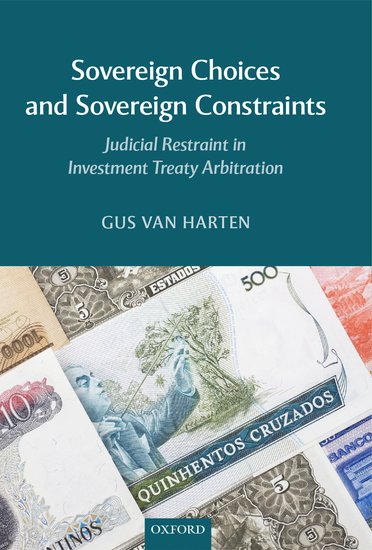
Gus Van Harten on investor-state arbitration

What is investor-state arbitration? And how does it impact upon people’s lives? Today, we present a Q&A with Gus Van Harten, author of Sovereign Choices and Sovereign Constraints, where he explains the fundamentals of investor-state arbitration and its place in international law.

Read More
Book thumbnail image

“Law Matters” for money market funds

By Viktoria Baklanova and Joseph Tanega
In the name of financial stability, institutional and product regulations since the 2008 financial crisis have forced banks and non-bank banks (the so-called “shadow banks”) to create insatiable compliance regimes. But the juggernaut does not stop here.

Read More
Book thumbnail image

How secure are you?

The internet has come a long way since the first “electronic mail” was sent back in 1971… but with its rapid advancement come challenges to cybersecurity and the increasing threat of cyberterrorism, both on an individual level as well as on a larger global scale. In their new book, Cybersecurity and Cyberwar: What Everyone Needs to Know, experts P.W. Singer and Allan Friedman warn us that we may not be as secure online as we think we are.

Read More
Book thumbnail image

Protecting yourself from the threat of cyberwarfare

With over 30,000 media reports and academic studies on the dangers of cyberterrorism, surely the threat today could not be greater? But as P.W. Singer, author of the bestselling Wired for War and co-author of Cybersecurity and Cyberwar: What Everyone Needs to Know, points out — not a single person has died in a cyberterror attack.

Read More
Book thumbnail image

How meaningful are public attitudes towards stem cell research?

By Nick Dragojlovic
When scientists in Scotland announced the successful cloning of Dolly the Sheep in 1997, it triggered a frenzy of speculation in the global media about the possibility of human cloning, and elevated ethical questions to the fore of public discussions about biotechnology. This debate had far-reaching consequences, with citizens’ perceived moral objections to human cloning contributing to the imposition of restrictive policies on stem cell research that involves the cloning of embryos.

Read More
Book thumbnail image

What (if anything) is wrong with infant circumcision?

By Eldar Sarajlic

Public controversies over non-therapeutic infant circumcision have become frequent occurrences in our time. Recently, an Israeli religious court fined a mother of a one-year-old for refusing to circumcise her son. We all remember last year’s circumcision controversy in Germany.

Read More
Book thumbnail image

Cybersecurity and cyberwar playlist

After writing Cybersecurity and Cyberwar: What Everyone Needs to Know, P.W. Singer compiled a list filled with songs to help readers get into the vibe of the book, which explores the emerging security challenges that continue to arise in the new digital age.

Read More
Book thumbnail image

Growing up in a recession

By Paola Giuliano and Antonio Spilimbergo
Economic crises have a traumatic effect on peoples’ psychology and attitudes, as superbly illustrated by John Steinbeck in The Grapes of Wrath and Of Mice and Men, both written in the middle of the Great Depression. The experience of the dramatic years during the Great Depression had a large impact on people and, ultimately, helped forge the social beliefs and attitudes that sustained a political system for many years.

Read More

What the bilingual brain tells us about language learning

One of the most common questions people ask revolves around when and how to learn a second language. One common view is that earlier is better. There is good evidence for this view. A number of studies have found that the earlier a person learns a second language, the better they perform on a number of tests.

Read More
Book thumbnail image

The legacy of the Superconducting Super Collider

By Stephen Blyth
Almost exactly twenty years ago, on 19 October 1993, the US House of Representatives voted 264 to 159 to reject further financing for the Superconducting Super Collider (SSC), the particle accelerator being built under Texas. $2bn had already been spent on the Collider, and its estimated total cost had grown from $4.4bn to $11bn; a budget saving of $9bn beckoned. Later that month President Clinton signed the bill officially terminating the project.

Read More
Book thumbnail image

In memoriam: Ariel Sharon

By Gil Troy
Ariel Sharon, Israel’s former prime minister who died recently at 85, after being in a vegetative state for eight years, helped save Israel at least twice. The first time, during the 1973 Yom Kippur War, won him worldwide acclaim. The second time, against Yasir Arafat’s terror war three decades later, earned him broad denunciations. That shift reflects the change in tactics in the decades-long war against Israel’s existence, and the resulting plunge in Israel’s popularity.

Read More