Oxford University Press's
Academic Insights for the Thinking World

  • Tag: Frank Close

Book thumbnail image

Frank Close on the Higgs boson

In 2013, the Nobel Prize for Physics was awarded jointly to François Englert and Peter W. Higgs for their work on what is now commonly known as the Higgs field and the Higgs boson. The existence of this fundamental particle, responsible for the creation of mass, was confirmed by the ATLAS and CMS experiments at CERN’s Large Hadron Collider in 2012.
Read More
Book thumbnail image

Edinburgh International Book Festival: Frank Close and Peter Higgs

By Frank Close
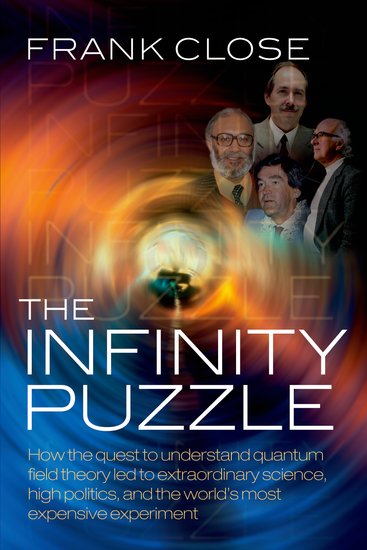
When I interviewed Peter Higgs at the Borders Book Festival in Melrose in June, he had been waiting 48 years to see if his eponymous boson exists. On July 4 CERN announced the discovery of what looks very much like the real thing. On August 13 I am sharing the stage with Peter again, this time in Edinburgh. We shall be discussing his boson and my book The Infinity Puzzle, which relates the marathon quest to find it. How has his life changed?

Read More
Book thumbnail image

Frank Close reflects on the new boson find

By Frank Close
Now that the boson has been found (yes, I know we physicists have to use science-speak to be cautious, but it’s real), I can stop hedging and answer the question that many have been asking me for months: how do six people who had an idea share a Nobel Prize that is limited to three? The answer is: they don’t. To paraphrase George Orwell: All may appear equal, but some are more equal than others.

Read More
Book thumbnail image

Professor Frank Close talks neutrinos

Neutrinos: what are they and why does nature need them? In a recent lecture Professor Frank Close gave an overview of the discovery of neutrinos, discussing how we are becoming increasingly aware of their significance and speculating over ways in which we may utilise them.

Read More
Book thumbnail image

Hunting the Neutrino

By Frank Close
Ray Davis was the first person to look into the heart of a star. He did so by capturing neutrinos, ghostly particles that are produced in the centre of the Sun and stream out across space. As you read this, billions of them are hurtling through your eyeballs at almost the speed of light, unseen.

Read More