Oxford University Press's
Academic Insights for the Thinking World

Book thumbnail image

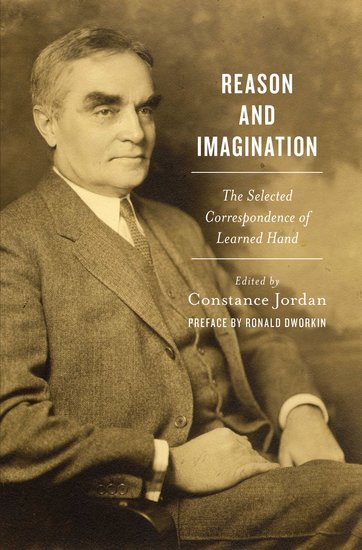
A letter from Learned Hand

Learned Hand (1872-1961) served on the United States District Court and is commonly thought to be the most influential justice never to serve on the Supreme Court. He corresponded with people in different walks of life, some who were among his friends and acquaintances, others who were strangers to him. In the letter below, Hand writes to Mary McKeon, a New Yorker troubled by Hand’s decision to invalidate the warrantless search and consequent arrest of the Soviet spy, Judith Coplon.
Read More
Book thumbnail image

HFR and The Hobbit: There and Back Again

By Arthur P. Shimamura
Is it the sense of experiencing reality that makes movies so compelling? Technological advances in film, such as sound, color, widescreen, 3-D, and now high frame rate (HFR), have offered ever increasing semblances of realism on the screen. In The Hobbit: An Unexpected Journey, we are introduced to the world of 48 frames per second (fps), which presents much sharper moving images than what we’ve seen in movies produced at the standard 24 fps.

Read More
Book thumbnail image

The death of Edmund Spenser

By Andrew Hadfield
Writing to his friend Dudley Carleton on 17 January 1599, the enthusiastic correspondent John Chamberlain (1553-1628) noted that “Spencer, our principall poet, coming lately out of Ireland, died at Westminster on Satturday last.” Chamberlain’s testimony confirms that Spenser died on 13 January. Chamberlain is a good recorder of court gossip and a barometer of what interested the upper echelons of London society.

Read More
Book thumbnail image

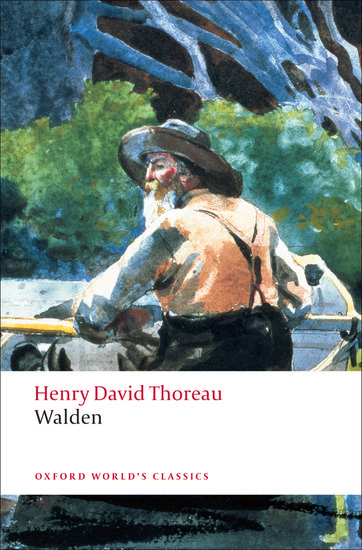
Choice in the true neces­saries and means of life

In 1845 Henry David Thoreau left his home town of Concord, Massachusetts to begin a new life alone, in a rough hut he built himself a mile and a half away on the north-west shore of Walden Pond. Walden is Thoreau’s classic autobiographical account of this experiment in solitary living, his refusal to play by the rules of hard work and the accumulation of wealth and above all the freedom it gave him to adapt his living to the natural world around him.

Read More
Book thumbnail image

The map she carried

By Marjorie Senechal
In the heyday of the British Empire, Britain’s second most-widely-read book, after the Bible, was: (a) Richard III (b) Robinson Crusoe (c) The Elements (d) Beowulf ? Why do I ask? “Since late medieval or early modern time,” Michael Walzer writes in Exodus and Revolution, “there has existed in the West a characteristic way of thinking about political change, a pattern that we commonly impose upon events, a story that we repeat to one another.”

Read More
Book thumbnail image

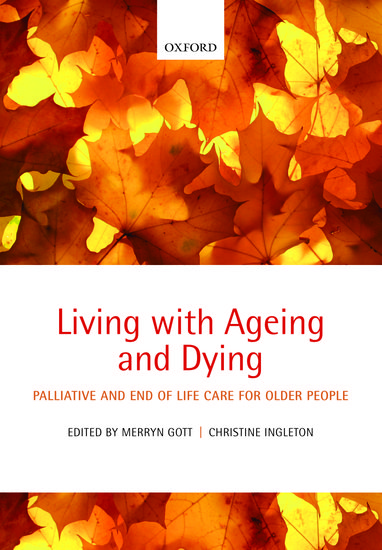
Do old people matter?

By Merryn Gott and Christine Ingleton
A couple of weeks ago one of us (MG) attended the biannual Hospice New Zealand conference in Auckland where there was a discussion session responding to the question ‘Do old people matter?’ The general feeling amongst delegates was that, of course they matter, or for some, of course we matter. The answer to the question was regarded to be self-evident; no debate was needed.

Read More
Book thumbnail image

The Beatles and “Please Please Me,” 11 January 1963

By Gordon R. Thompson
Although “Love Me Do” had been the Beatles’ induction into Britain’s recording industry, “Please Please Me” would bring them prominently into the nation’s consciousness. The songwriters, the band, the producer, and the manager all thought that they had finally found a winning formula. An advertisement in the New Musical Express proclaimed that the disc would be the “record of the year,” even as it raised a chuckle among industry insiders; but the hyperbole would prove prophetic.

Read More
Book thumbnail image

Autism: a Q&A with Uta Frith

We spoke to Uta Frith, author of Autism: A Very Short Introduction and asked her about diagnosis, the perceived links between autism and genius, and how autism is portrayed in culture.

Read More
Book thumbnail image

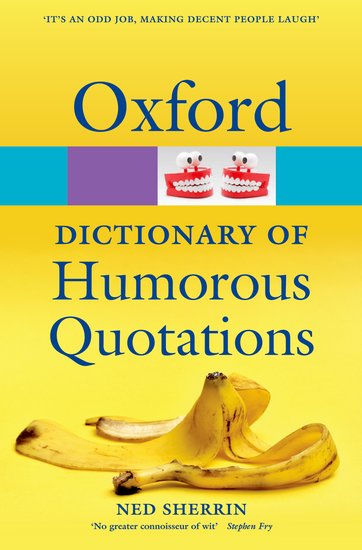
A comic quotation quiz

Moliere wrote in La critique de l’école des femmes (1663) that “it’s an odd job, making decent people laugh.” In the hopes that 2013 will be filled with delightful oddity and humor, we present this quiz, drawn from the Oxford Dictionary of Humorous Quotations, 4th edition. Edited by the late Ned Sherrin, the dictionary compiles words of wit and wisdom from writers, entertainers and politicians.

Read More
Book thumbnail image

The changing face of opera

Outreach and innovation are two buzzwords that pop up again and again in relation to established “classical” music institutions such as symphony orchestras and opera companies. In an effort to build younger audiences, many of these institutions have introduced new programs that attempt to do away with the of the concert-going experience, such as expensive tickets or the need for a certain type of attire, that might discourage younger or less experienced listeners from attending.

Read More
Book thumbnail image

‘Grooming’ and the sexual abuse of children

By Dr Anne-Marie McAlinden
The word “grooming” has become synonymous with child sexual abuse. It is often used to describe situations of extra-familial abuse–where “predatory strangers” befriend children who were previously unknown to them. Two of the most prominent social connotations of the term are “on-line grooming” committed via the internet and “institutional grooming” and abuse committed by those in positions of power and trust.

Read More

How come the past of ‘go’ is ‘went?’

By Anatoly Liberman
Very long ago, one of our correspondents asked me how irregular forms like good—better and go—went originated. Not only was he aware of the linguistic side of the problem but he also knew the technical term for this phenomenon, namely “suppletion.” One cannot say the simplest sentence in English without running into suppletive forms. Consider the conjugation of the verb to be: am, is, are. Why is the list so diverse? And why is it mad—madder and rude—ruder, but bad—worse and good—better?

Read More
Book thumbnail image

London place names, but not as you know them

This week marks the 150th anniversary of the London Underground. The Metropolitan Railway line, completed in 1863, then running from Paddington to Farringdon Street, was the first part of the London Underground to be built, and was the first Underground railway up and running in the world. More than 2,000 workers built the line, and the first carriages were pulled by steam before electrification was introduced in the early nineteenth century. Today, the Tube, as it quickly became known, is often an area of frustration in many commuters’ lives, though we have to admit that without it we would be stranded (probably somewhere near the M25). In honour of its longstanding service, here are ten little-known yet interesting facts about the locations in which underground stations can be found today.

Read More
Book thumbnail image

Teaching algorithmic problem-solving with puzzles and games

By Anany Levitin
In the last few years algorithmic thinking has become somewhat of a buzz word among computer science educators, and with some justice: ubiquity of computers in today’s world does make algorithmic thinking a very important skill for almost any student. There are few colleges and universities that require non-computer science majors to take a course exposing them to important issues and methods of algorithmic problem solving.

Read More
Book thumbnail image

Reveries of a solitary fell runner

By Matthew Flinders
New Year is – or so I am told – a time to reflect upon the past and to consider the future. Put slightly differently, it is a time to think. Is it possible, however, that we may have lost – both individually and collectively – our capacity to think in a manner that reaches beyond those day-to-day tasks that command our attention?

Read More